PERSONAL WATERCRAFT UPDATE
With minor exceptions, reactions to the ban on personal watercraft
seemed negligible. Most residents were delighted with the quieter, safer,
cleaner lake. However, on two separate occasions (that I’m aware of)
people were upset. At the beginning of summer, an out-of-town resident
launched his jet-ski without prior knowledge of the new law. He was
politely informed by a neighbor and removed it.
The second party knew but thought it unfair since they hadn’t been
allowed to vote in the town elections (they weren’t full-time
residents). However, the law had been passed by town voters and enacted in
April by the State Legislature. We had notified all lake residents in our
Spring Newsletter and two informational signs were erected by the Town,
one at the Public Beach and one at the boat launch.
We hope folks will accept this new law in the spirit for which it was
enacted…to help protect and preserve the health of the lake and to
prevent further noise and unburnt-gas pollution.
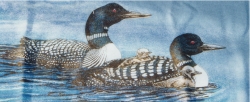 |
LOONS AND LEAD
|
| Maine Audubon Society provided an
interesting speaker at our Annual Meeting on July 8. Josh McNaughton,
a senior in the Wildlife Ecology program at University of Maine (Orono)
gave a slide presentation on loons, their biology, history and
habits. The program included threats to them and to other wildlife
on Maine’s great lakes, emphasizing the impact of lead sinkers on
loon populations in New England..
The Department of Inland Fisheries and Wildlife reports
"lead sinkers and jigs cause fatal lead poisoning in loons and
other waterfowl…lead ingestion is the #1 killer of loons in Maine.
Just one sinker can kill." They suggest using steel, tin,
bismuth or plastic instead. Local tackle shops and larger stores
carry them. It’s necessary to properly dispose of old lead
sinkers.
McNaughton’s efforts to increase awareness and use of lead-free
alternatives were highlighted by free samples of lead-free tackle
given to the audience as well as resource material on loons in
Maine. For further information about lead-free tackle manufacturers,
contact Maine Audubon Society, 20 Gilsland Farm Rd., Falmouth, ME.
04105, Tel. #(207) 781-0974, or www.maineaudubon.org. |
|
LADYSLIPPER POPULATION GROWING

Ladyslipper - A Protected Species |
Remember the beautiful,
rare, orchid-like flowers, growing in dark velvety woods? The
species Cypripedium, which was becoming extinct and is now protected
by law, is making a comeback.
|
| Our dear
neighbor and friend, James Holleran, who passed away this past
month, was elated when he and his wife Susie discovered 23
Ladyslippers growing (in June) in a small secluded area. Finding
them while on their daily bike rides, they proudly showed them to
me. Their excitement was contagious. For the sake of the
ladyslippers, their location shall remain classified.
James loved the lake and all it encompassed. Whenever I may see a
Ladyslipper, I’ll think of James, Susie and their pure delight. We
shall miss you. |
|